Most of students search over Google for Haryana Board (HBSE) Important Questions 2026. Here is the Main reason because HBSE Board Says that in HBSE Exam 2026 (last 3 Years of Questions will Repeat) so that here are the selected List of Questions of Haryana Board For Class 10.
HBSE Class 10 Math Standard + Basic MCQ Important Question Answer 2026
Note : – For Math Standard Students, and Math Basic Students MCQ Came with same difficulty Level. So Practice all.
Chapter 1 – Real Numbers
1. Which of the following is not a rational number? Most Important
(A) 
(B) 
(C) 
(D) 
Ans – (B)
2. Which of the following rational number is a terminating decimal ?
(A) 
(B) 
(C) 
(D) None of these
Ans – (B)
3. If H.C.F. of 225 and 135 is 45, then their L.C.M. is :
(A) 675
(B) 1025
(C) 835
(D) 345
Ans – (A) 675
4. If H.C.F of 26 and 91 is 13, then their L.C.M is:
(A) 184
(B) 183
(C) 182
(D) 181
Ans – (C) 182
5. The relation between HCF and LCM of 12 and 20 will be:
(A) HCF > LCM
(B) HCF < LCM
(C) HCF = LCM
(D) None of these
Ans – (B) HCF < LCM
Chapter 2 – Polynomials
1. The Zeroes of Polynomial 4x2 – 4x + 1 are :
(A) 
(B) 
(C) 
(D) None of the above
Ans – (B)
2. The Zeroes of Polynomial x² + 7x + 10 are
(A) (2, 5)
(B) (-2, -5)
(C) (-2, 5)
(D) (2, -5)
Ans – (B) (-2, -5)
3. The zeroes of 6x2 – 7x – 3 are:
(A) 
(B) 
(C) 
(D) None of these
Ans – (A)
4. If sum of roots of the quadratic polynomial is  and product is
  , then the quadratic polynomial is :
(A) 4x2 + x + 1
(B) 4x2 – x – 1
(C) 4x2 – x + 1
(D) 4x2 + x – 1
Ans – (A) 4x2 + x + 1
5. Which one is polynomial ?
(A) 
(B) 
(C) 
(D) x³ +1
Ans – (D) x³ +1
6. Sum of zeros of the quadratic polynomial 2x2 – 5x + 2 is :
(A) -5
(B) 1
(C) 
(D) -1
Ans – (C)
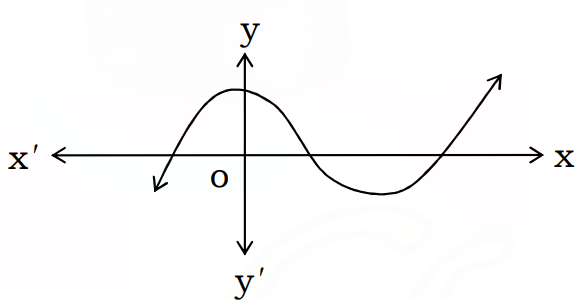
7. The graph given below is graph of a polynomial the number of zeros of this polynomial is:
(A) 0
(B) 1
(C) 2
(D) 3
Ans – (D) 3
Chapter 3 – Pair of Linear Equations in Two Variables
1. If in equations a1x + b1y + c₁ = 0 and a₂x+b₂y+c2=0, 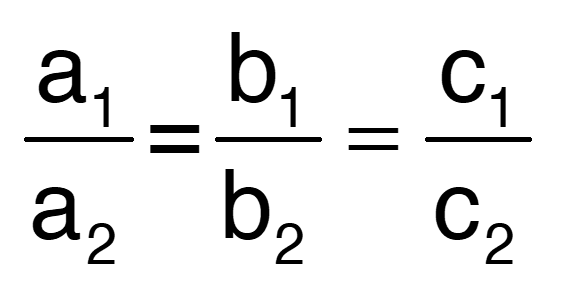 then which of the following is true?
(A) Unique solution
(B) No solution
(C) Infinite solutions
(D) None of these
Ans – (C) Infinite solutions
2. If in equations a1x + b1y + c₁ = 0 and a2x + b2y + c2 = 0, 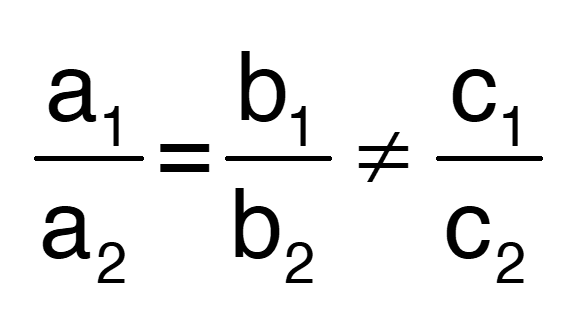 then which of the following is true?
(A) Intersecting lines
(B) Coincident lines
(C) Parallel lines
(D) None of these
Ans – (C) Parallel lines
3. Solution of a pair of linear equations x – 2y + 3 = 0 and 3x – 6y + 9 = 0 will be :
(A) Unique solution
(B) No solution
(C) Infinitely many solutions
(D) None of these
Ans – (C) Infinitely many solutions
4. Solution of a pair of linear equations x – 2y + 5 = 0 and 3x – 6y + 10 = 0 will be:
(A) Unique solution
(B) No solution
(C) Infinitely many solutions
(D) None of these
Ans – (B) No solution
5. The solution of linear equations 3x + 4y = 10 and x – y =1 is :
(A) x=1,y=2
(B) x=3, y=1
(C) x=2, y=1
(D) x=4, y=3
Ans – (C) x=2, y=1
6. The solution of linear equations s – t=3 and  is :
is :
(A) s=3, t=5
(B) s=6, t=9
(C) s=9, t=6
(D) s=5, t=3
Ans – (C) s=9, t=6
7. Linear equations 2x – 3y + 9 = 0 and 4x – 6y + 18 = 0 represents lines :
(A) Intersecting
(B) Coincident
(C) Parallel
(D) None of these
Ans – (B) Coincident
8. Point P(6, -4) lies in which quadrant ?
(A) First
(B) Second
(C) Third
(D) Fourth
Ans – (D) Fourth
Chapter 4 – Quadratic Equations
1. Which of the following is a quadratic equation?
(A) (x+1)=(x-3)2
(B) (x+4)3 = 3x(x + 1)
(C) 4x²+5= (2x+7)2
(D) (x-2) (x+1) = (x-1) (x+3)
Ans – (A) (x+1)=(x-3)2
2. Which of the following is a quadratic equation?
(A) (x-1)(x+3) = (x-7) (x+5)
(B) (2x-1)(2x+1) = (x-2)2
(C) (x+4)3 = 3x(x + 1)
(D) 4x² + 5 = (2x+7)2
Ans – (B) (2x-1)(2x + 1) = (x-2)2
3. If the roots of the quadratic equation 2x²+kx+2=0 are equal, then the value of k is :
(A) +2
(B) ±5
(C) ±3
(D) ±4
Ans – (D) ±4
4. Choose the correct option: If the roots of the quadratic equation 3x²+kx+3=0 are equal, then the value of k is:
(A) ±6
(B) ±3
(C) ±9
(D) None of these
Ans – (A) ±6
5. The value of k for which the roots of 2x² + kx + 3 = 0 are equal, is:
(A) 0
(B) ± 24
(C) 
(D) 
Ans – (C)
6. Roots of equation 3x² + x – 4 = 0 are :
(A) 
(B) 
(C) 3,-4
(D) None of these
Ans – (B)
7. Discriminant of equation 2x² + x – 6=0 is :
(A) 49
(B) 7
(C)-12
(D) None of these
Ans – (A) 49
Chapter 5 – Arithmetic Progressions
1. 15th term of A.P. 0, -4, -8, -12, …….. is :
(A) 56
(B) 60
(C)-56
(D) -60
Ans – (C)-56
2. The 10th term of the A.P. 3, 7, 11, 15,……… is:
(A) 43
(B) 38
(C) -37
(D) 39
Ans – (D) 39
3. If 3rd and 9th term of an A.P. are 4 and -8 respectively, then its 6th term is :
(A) -6
(B) 14
(C) -8
(D) -2
Ans – (D) -2
4. If 3rd and 7th term of an A.P. are 5 and 9 respectively, then its 11th term is :
(A) 13
(B) 14
(C) 15
(D) 16
Ans – (A) 13
5. Which one is an A. P. series ?
(A) 2, 4, 8, 12, ……..
(B) 0.2, 0.22, 0.222, …………
(C) -10, -6, -2, 2, ………….
(D) 1, 3, 9, 27, …….
Ans – (C) -10, -6, -2, 2, ………….
6. In an A. P. 10, 7, 4, …., 30th term is:
(A) 97
(B) 77
(C) -77
(D) None of these
Ans – (C) -77
7. 15th term of A. P. 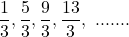 is:
is:
(A) 
(B) 6
(C) 5
(D) 19
Ans – (D) 19
8. If 3rd term of an A. P. is 5 and 7th term is 13, then its common difference is :
(A) 1
(B) 2
(C) 3
(D) 4
Ans – (B) 2
Chapter 6 – Triangles
1. Sides of some triangles are given below. Which of the two triangles are similar?
(i) 6 cm, 8 cm, 12 cm (ii) 5 cm, 7 cm, 9 cm. (iii) 3 cm, 4 cm, 6 cm.
(A) (i) and (ii)
(B) (i) and (iii)
(C) (ii) and (iii)
(D) None of these
Ans – (B) (i) and (iii)
2. If ratio of the sides of two similar, triangles is 2 : 3, then the ratio of their areas is :
(A) 
(B) 2:3
(C) 4:9
(D) None of these
Ans – (C) 4:9
3. If areas of two similar triangles are in the ratio 4 : 9, then ratio of their corresponding sides are:
(A) 2 : 3
(B) 16 : 81
(C) 3 : 2
(D) 4 : 9
Ans – (A) 2 : 3
4. If areas of two similar triangles are in the ratio 9 : 16, then ratio of their corresponding sides are:
(A) 81 : 256
(B) 9 : 16
(C) 3 : 4
(D) √3 : √4
Ans – (C) 3 : 4
5. If the areas of two similar triangles are 36m² and 121 m² respectively, the ratio of there corresponding sides is:
(A) 11:6
(B) 6:11
(C) 9:11
(D) None of these
Ans – (B) 6:11
6. If two sides of a right angle triangle are 4 cm and 5 cm, then the hypotenuse of the triangle is of length:
(A)  cm
cm
(B) 3 cm
(C) 9 cm
(D) None of these
Ans – (A) cm
7. ΔMNL and ΔQPR are similar triangles. In given figure which similarity criterion is used?

(A) S. S. S.
(B) A. A. A.
(C) S. A. S.
(D) None of these.
Ans – (C) S. A. S.
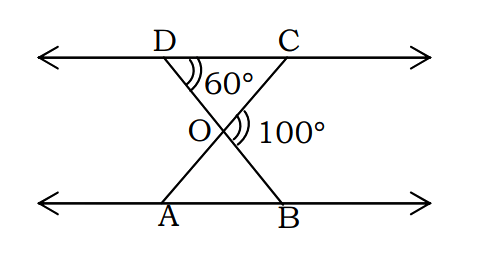
8. In the given figure ΔODC ∼ ΔΟΑΒ, ∠ΒΟC = 100°, ∠ODC = 60°, then ∠OAB is equal to:
(A) 20°
(B) 80°
(C) 60°
(D) 40°
Ans – (D) 40°
Chapter 7 – Coordinate Geometry
1. The distance between the points (4, 2) and (-1, -1) is :
(A) 
(B) 
(C) 
(D) 6
Ans – (B)
2. The distance between the points (-5, 7) and (-1, 3) is:
(A) 4√2
(B) 3√2
(C) 5√2
(D) √34
Ans – (A) 4√2
3. The distance of point (5, -7) from origin is :
(A) 
(B) -2
(C) 2
(D) 12
Ans – (A)
4. The coordinates of the point which divides the line segment joining the points (4, -3) and (8, 5) in the ratio 3: 1 internally are:
(A) (-3, 5)
(B) (4, -2)
(C) (3, 7)
(D) (7, 3)
Ans – (D) (7, 3)
5. The co-ordinates of the point which divides the join of (-1, 7) and (4,-3) in the ratio 2 : 3 is:
(A) (3, 1)
(B) (5, 2)
(C) (2, 5)
(D) (1, 3)
Ans – (D) (1, 3)
6. Coordinate of mid point of line joining two points (-1, 7) and (4, -3) are :
(A) 
(B) 
(C) 
(D) 
Ans – (B)
7. The ratio in which the y-axis divides the line-segment joining the points (5, -6) and (-1,-4) is:
(A) 1:5
(B) 5:1
(C) 3:2
(D) 2:3
Ans – (B) 5:1
8. The ratio in which the x-axis divides the line-segment joining the points A(1, -5) and B(-4, 5) is:
(A) 2:1
(B) 1:1
(C) 1:2
(D) 3:2
Ans – (B) 1:1
9. The point on the x-axis which is equidistant from (2,-5) and (-2, 9) is : Most Important
(A) (0, -7)
(B) (-7, 0)
(C) (-5, 0)
(D) (0,-5)
Ans – (B) (-7, 0)
10. The area of triangle whose vertices are (1, -1), (-4, 6) and (-3,-5) is :
(A) 
(B) 8
(C) 24
(D) None of these
Ans – (C) 24
Chapter 8 – Introduction to Trigonometry
1. The value of 9sec2A – 9tan2A is:
(A) 1
(B) 8
(C) 9
(D) 0
Ans – (C) 9
2. The value of 5sec² A-5 tan2A is:
(A) 1
(B) 2
(C) 9
(D) 5
Ans – (D) 5
3. If sin A =  , then cos A is :
(A) 
(B) 
(C) 
(D) None of these
Ans – (B)
4.  is equal to :
(A) tan 90°
(B) 1
(C) sin 45°
(D) 0
Ans – (D) 0
5.  is equal to :
(A) sin 60°
(B) cos 60°
(C) tan 60°
(D) sin 30°
Ans – (C) tan 60°
6. In ΔABC, right-angled at B, AB = 24 cm, BC = 7 cm. The value of sin A is:
(A) 
(B) 
(C) 
(D) None of these
Ans – (A)
7. If tan A =  then the value of cos A is :
(A) 
(B) 
(C) 
(D) 
Ans – (D)
8. The value of  is:
is:
(A) cos 60°
(B) tan 60°
(C) sin 60°
(D) tan 30°
Ans – (A) cos 60°
Chapter 9 – Some Application of Trigonometry
1. A tower stands vertically on the ground. From a point on the ground which is 15m away from the foot of the tower, the angle of elevation of the top of the tower is found to be 30° . Then the height of the tower is
(A) 15√3
(B) 10√3
(C) 5√3
(D) 45√3
Ans. (C) 5√3
2. The ratio of the length of a rod and its shadow is 1:√3. The angle of elevation of the sum is:
(A) 90°
(B) 30°
(C) 60°
(D) 45°
Ans. (B) 30°
3. The angles of elevation of the top of a tower from two points at a distance of 4m and 9m from the base of the tower and in the same straight line with it are complementary. Then the height of the tower is
(A) 2m
(B) 4m
(C) 6m
(D) 8.625m
Ans. (C) 6m
4. A boy is traveling from a point towards a tower. He travelled 2 unit distance when angle of elevation changes from 30° to 60°. Now how much more distance he should have to travel to reach exactly at the base of tower.
(A) √3 unit
(B) 1 unit
(C) 0.5 unit
(D) √2 unit
Ans. (B) 1 unit
5. A boy is traveling from a point towards a tower. He travelled 2 unit distance when angle of elevation changes from 30° to 60°. What is the height of tower?
(A) √3 unit
(B) 1 unit
(C) 0.5 unit
(D) √2 unit
Ans. (A) √3 unit
6. If the height of a vertical wall is 4m. A ladder is leaned against wall at the angle of depression 15°. Then the length of ladder is
(A) 4.5√3m
(B) 5m
(C) 3m
(D) 4√3m
Ans. (B) 5m
7. A tree breaks due to storm and the broken part bends so that the top of the tree touches the ground making an angle 30° with it. The distance between the foot of the tree to the point where the top touches the ground is 8m. Then the height of the tree is
(A) 8√3m
(B) 16√3m
(C) 8√2m
(D) none of the above
Ans. (A) 8√3m
8. The shadow of a tower standing on a level plane is found to be 40m longer when the sun’s altitude is 45°, than when it is 60°. The height of the tower is
(A) 30(3 + √3) m
(B) 40(3 + √3) m
(C) 20(3 + √3) m
(D) 10(3 + √3) m
Ans. (C) 20(3 + √3) m
Chapter 10 – Circles
1. If tangents PA and PB from a point P to a circle with centre O are inclined to each other at angle of 80°, then ∠POA is equal to : Most Important
(A) 50°
(B) 60°
(C) 70°
(D) 80°
Ans – (A) 50°
2. If tangent PA and PB from a point P to a circle with centre O are inclined to each other at an angle 100°, then ∠POA is equal to ……..
(A) 40°
(B) 80°
(C) 50°
(D) None of these
Ans – (A) 40°
3. The maximum number of parallel tangents to a circle is:
(A) 1
(B) 2
(C) 3
(D) 4
Ans – (B) 2
4. Number of tangents drawn from a point outside the circle are:
(A) 1
(B) 2
(C) 0
(D) 4
Ans – (B) 2
5. From a point P, the length of tangent to a circle is 24 cm and distance of P from the centre is 25 cm. The radius of the circle is : Most Important
(A) 12 cm
(B) 12.5 cm
(C) 1 cm
(D) 7 cm
Ans – (D) 7 cm
6. A tangent PQ at a point P of a circle of radius 5 cm meets a line through the centre O at a point Q, so that OQ 12 cm. Then the length PQ is :
(A) 12cm
(B) 13 cm
(C) 8.5 cm
(D) √119 cm
Ans – (D) √119 cm
Chapter 11 – Areas Related to Circles
1. Area of sector of the circle of angle θ is:
(A) 
(B) 
(C) 
(D) 
Ans – (B)
2. Length of an arc of a sector of angle is :
(A)
(B) 
(C)
(D) None of these
Ans – (A)
3. The ratio of circumference and diameter of a circle is:
(Α) 2π : 1
(Β) π: 1
(C) 1:1
(D) None of these
Ans – (Β) π: 1
4. Area of the sector of a circle with radius 6 cm and angle of sector 30° is:
(A) 7π cm²
(B) 9π cm²
(C) 3π cm²
(D) бπ cm²
Ans – (C) 3π cm²
5. Area of the sector of a circle with radius 14 cm and angle of sector 60° is:
(A) 154 cm²
(B)  cm²
cm²
(C)  cm²
cm²
(D) 196 cm²
Ans – (C) cm²
6. The length of the minute hand of a clock is 14 cm. The area swept by the minute hand in 5 minutes is :
(A) 162 cm2
(B)  cm2
cm2
(C)  cm2
cm2
(D) None of these
Ans – (B) cm2
7. The length of the minute hand of a clock is 7 cm. The area swept by the minute hand in 15 minutes is:
(A)  cm²
cm²
(B) cm²
(C)  cm²
cm²
(D)  cm²
cm²
Ans – (A) cm²
Chapter 12 – Surface Areas and Volumes
1. Surface area of sphere of radius 2.1 cm is:
(A) 80.3 cm²
(B) 55.44 cm²
(C) 191.5 cm²
(D) 47.09 cm²
Ans – (B) 55.44 cm²
2. Surface area of sphere of radius 2.8 cm is:
(A) 98.98 cm2
(B) 98.56 cm2
(C) 97.56 cm2
(D) 98.38 cm2
Ans – (B) 98.56 cm2
3. The diameter of the base of right circular cylinder is 2r and its height is h. The curved surface area is:
(A) πr²h
(B) 2πrh
(C) 2πr (r + h)
(D) None of these
Ans – (B) 2πrh
4. The volume of the cuboid, whose length, breadth and height are 12 m, 10 m and 8 m respectively is:
(A) 592 m³
(B) 960 m³
(C) 480 m³
(D) None of these
Ans – (B) 960 m³
5. The radius of the base of a cone is 7 cm and the height is 6 cm. Its volume is :
(A) 924 cm³
(B) 308 cm³
(C) 1232 cm³
(D) None of these
Ans – (B) 308 cm³
6. The radius of the base of a cone is 4 cm and the height is 3 cm. Its CSA is :
(A) 20π cm²
(В) 12π cm²
(C) 30πcm²
(D) None of these
Ans – (A) 20π cm²
Chapter 13 – Statistics
1. The mean of the following data is :
| Class-interval | 0-2 | 2-4 | 4-6 | 6-8 | 8-10 | 10-12 | 12-14 |
| Frequency | 1 | 2 | 1 | 5 | 6 | 2 | 3 |
(A) 10.5
(B) 8.1
(C) 11.5
(D) 9.5
Ans – (B) 8.1
2. The mean of the following data is :
| Class-interval | 0-4 | 4-8 | 8-12 | 12-16 | 16-20 |
| Frequency | 5 | 4 | 5 | 2 | 4 |
(A) 9.2
(B) 8.5
(C) 10.2
(D) 7.6
Ans – (A) 9.2
Chapter 14 – Probability
1. Which of the following can not be the probability of an event?
(A) 
(B) 15%
(C) 0.7
(D) -1.5
Ans – (D) -1.5
2. Which of the following cannot be the probability of an event?
(A)
(B) -1.3
(C) 17%
(D) 0.5
Ans – (B) -1.3
3. Probability of getting 8 in a single throw of a die is:
(A) 1
(B) 0
(C) 
(D) 
Ans – (B) 0
4. If P(E) 0.05, then the P (not E) is:
(A) 0.05
(B) 0.5
(C) 0.95
(D) None of these
Ans – (C) 0.95